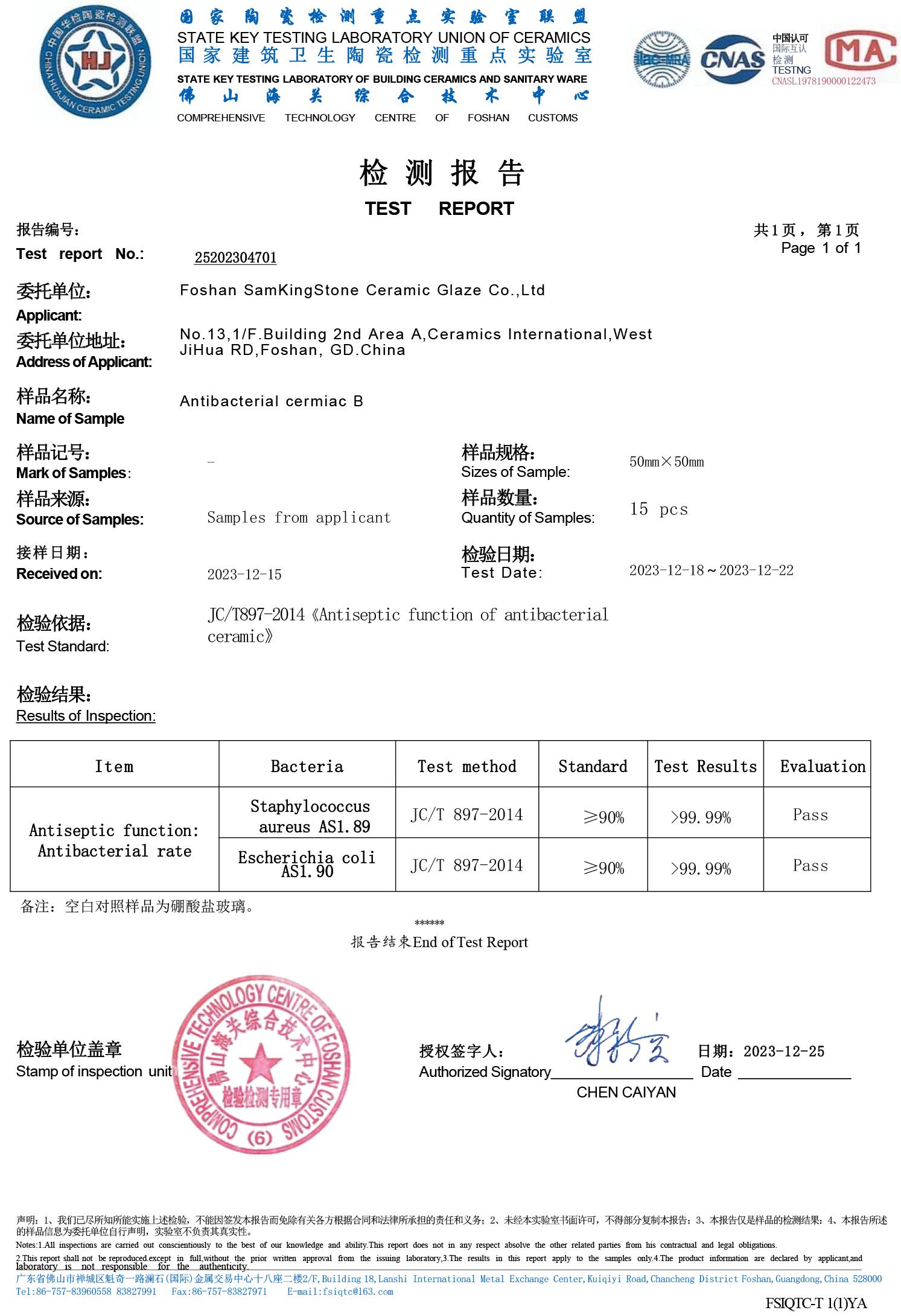



Application of antibacterial materials (glaze)
2025-08-13
The antibacterial material (glaze) of our company has the advantages of high safety, wide antibacterial, good slow-release, long-term durability, economic and environmental protection, and convenient use in ceramic materials. It has been widely used in the market and recognized by customers.
At present, there are four different ways to apply antibacterial materials:
1. With the addition of active nano-TiO 2, it can achieve antibacterial effect under the action of photocatalysis. Its product has no antibacterial effect under the condition of dark corners and no light.
2. Add Ag ions to resist bacteria. In the high temperature sintering of ceramics, using Ag stone to resist high temperature and lose more, its antibacterial effect is not ideal and the cost is high.
3. Nano-ZnO antibacterial materials are added to resist bacteria. Because the preparation process of nano-ZnO is complex, the cost is high.
4. Add oolan tea spar, a new inorganic material to achieve antibacterial effect.
The company has concentrated its advantageous human resources, including many masters and doctors, and cooperated with several listed companies in depth with South China University of Technology, Shaanxi University of Science and Technology, and Jingdezhen Ceramic University. After several years of hard research and development, the system has developed a series of products: high temperature, low temperature, matte, bright and other glazes, which have been widely recognized in the market for their application in the series products of slate, glazed tile and sanitary ware.
Due to the new inorganic materials added to the product, including 15 rare earth elements and rare metal element rubidium Rb; Because metal elements can release a large number of electrons under the action of visible light and can excite the rare earth elements in the new inorganic materials in the formula, the transition energy band electronic transition, resulting in sterilization effect, and this change is reversible and repeated, and the antibacterial effect is lasting.